Engineering Regenerative Environments and Devices
Adaptive therapy in a designed enclosure, against the degradative load of ordinary surroundings.
Medicine treats the body. This is about the conditions the body is kept in.
A person spends most of a life indoors, and the room is not a neutral container. Ionising and non-ionising radiation. Light that arrives at the wrong hour and never at the right intensity. Particulates and the chemistry of indoor air. Thermal and acoustic load. Immobility enforced by furniture and floor plans. These are continuous inputs, and they do not cancel out. They point one way.
Say it plainly, because the rest follows from it: the default environment is degradative. Not catastrophically, not visibly, not at a rate anyone notices in a day — continuously, in one direction, for decades. The body does not age on its own schedule while the room stands by. The room participates.
One night, two rooms
Take a single night's sleep in an ordinary bedroom. Carbon dioxide climbs through the small hours because the door is shut. Light leaks in at a wavelength and an hour that tell the wrong story. Temperature follows the building's thermostat rather than the sleeper's thermoregulation, which is not the same curve. The street sets the noise floor. Nothing in the room knows anything about the person in it, and nothing that happens to them is recorded. The night is a black box. It leaves no trace except how they feel in the morning, which is the least reliable instrument in the house.
Now the same person in an enclosure built for the purpose. The air is held rather than left to drift. Light follows their phase rather than the window's. Temperature tracks the sleep stage instead of the wall. The envelope is closed against what should not come in and opened deliberately for what should.
The difference that matters is not comfort. It is that the second night is measured, and therefore the third night can be different.
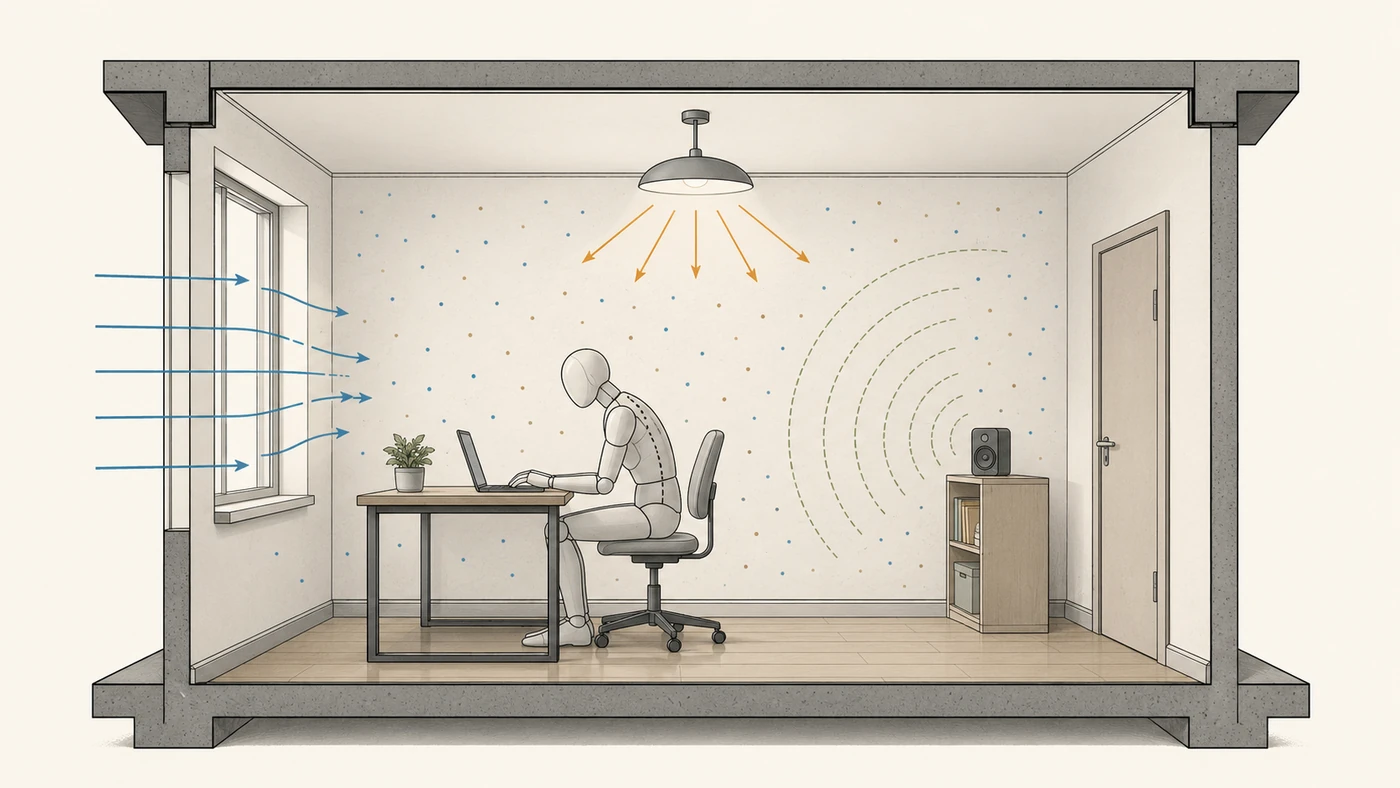
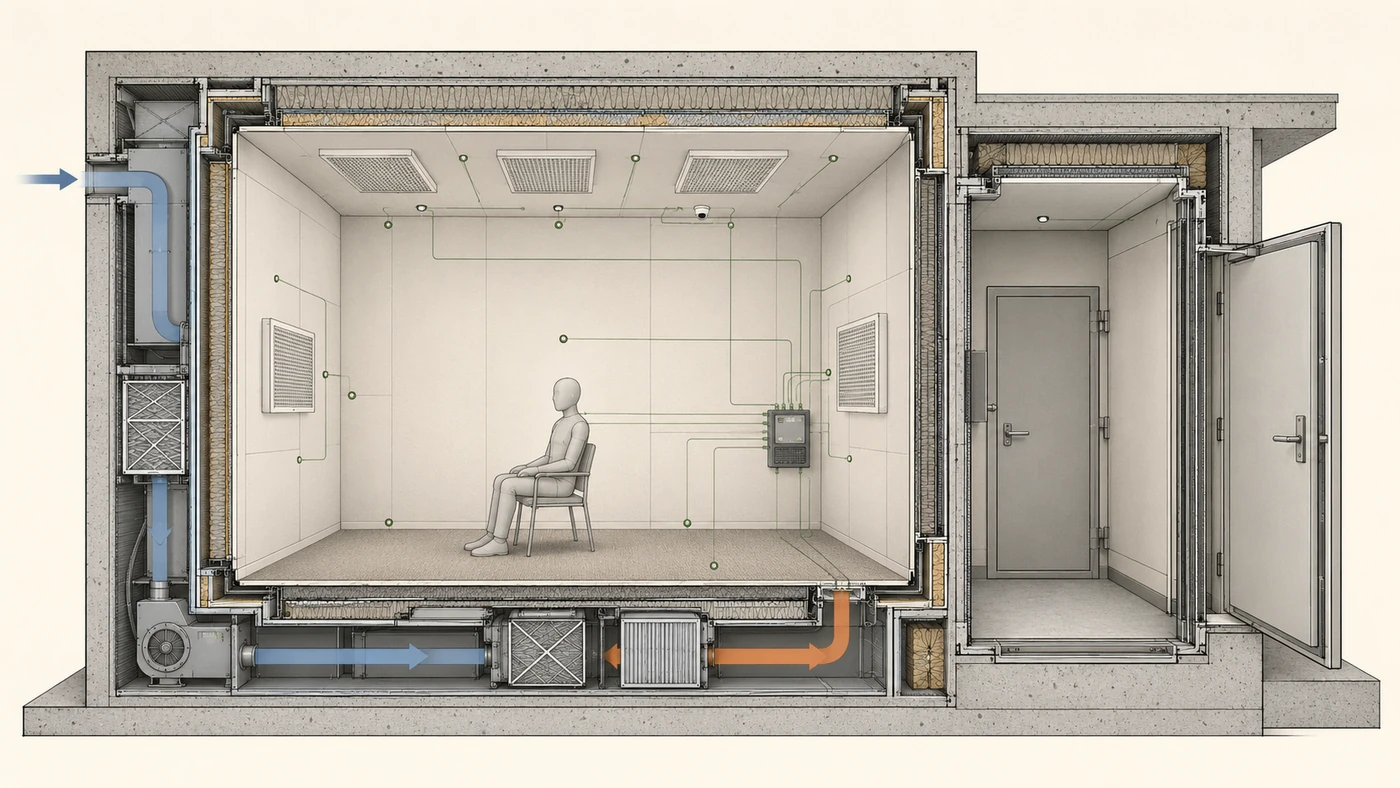
An open loop is a wellness suite. A closed loop is engineering.
The object is an engineered envelope around a person, with a deliberate boundary. Most often that boundary is architectural — a capsule, a chamber, a treatment room, a recovery suite, an apartment, a workplace. It can also be a hull that travels: a deployable care bay, a transport capsule. It can be worn, with the boundary drawn at the skin rather than the wall.
What makes it one object rather than a pile of appliances is not that it has walls. It is that the boundary is chosen, and the systems inside it are designed together. That test does real work at the edges: a fitness band or a single adhesive patch is not in this class — not because it is small or worn, but because it carries one function out of three and cannot close anything.
Three functions run inside it, and the point is not that there are three. The point is what happens when they are closed on one another.
Intervention acts on the body — the actuator. Sensing measures the body and the enclosure — the instrument. Life support holds the envelope inside which the other two mean anything — the plant. Run them independently and you have a room with good equipment in it: a person receives a modality, feels something, leaves, and nothing about what was delivered or what it did survives the appointment. Close them — measurement drives what the actuator does, the actuator's effect returns as measurement, and the envelope holds the conditions steady enough that the difference between them is attributable — and you have a machine with a person inside it.
The purpose of closing it is not to produce data. It is to control delivery. Open-loop, every intervention is given blind and identically to everyone — same setting, same duration, same protocol, whatever the person in front of it is actually doing. Closed, the dose answers to the person receiving it, which is what therapy has come to mean in every branch of medicine that grew up. Measurement is how the loop knows. It is not what the loop is for.
The evidence problem falls out of the same fact, which is why this page and the rest of the atlas are about one thing rather than two.
Look at what the atlas keeps finding, one row at a time: no dosimetry. Field strength at the target never characterised. Exposure never logged. Outcome never measured on the same clock as the exposure. The claim is not usually that the field failed a trial — it is that nothing was in a position to record what happened. That is what an open loop produces, by construction. Closing it does not make a modality work. It makes a modality answerable, which is the precondition for ever finding out.
And the honest version of the same point, which the field should say out loud more often: even the modalities this atlas grades highest are still argued about at the level of mechanism. Transcranial direct-current stimulation is cleared, studied and reviewed, and reviewers continue to disagree about how its effects are actually produced — which is precisely why protocol optimisation is still an open research problem rather than a settled recipe. Continuous measurement inside an occupied enclosure is one of the few ways that question gets easier rather than louder.
Why now, and not twenty years ago
Nothing in the paragraphs above requires a modality that did not exist in 2005. Three other things changed.
Sensing left the clinic. Measurement used to be an event you travelled to and paid for; it is now continuous, wearable or contactless, and cheap enough to be ambient. Episodic measurement was never a scientific choice — it was a scheduling constraint. Remove it and the questions you can ask change shape.
Life support left its three fields. Closed-loop atmospheric control, filtration, pressure and gas management, radiation shielding, circadian lighting — all of it matured inside spaceflight, diving and elite sport, all of it engineered for extreme cases, and all of it has since become small enough and cheap enough to install in a room that is not extreme at all.
Computation crossed from describing bodies to predicting them. Multiscale physiological modelling and digital twins are moving from retrospective description toward forecasting a trajectory — what a body will do next under injury, load or intervention, and how a specific intervention would change that trajectory. A loop needs a controller, and a controller needs a model that predicts consequences rather than merely reporting states. That is the piece that was missing, and it is the piece currently arriving.
Two design axes: how long, and where the boundary sits
How long a person stays, and in what role, changes the engineering problem more than the choice of modality does.
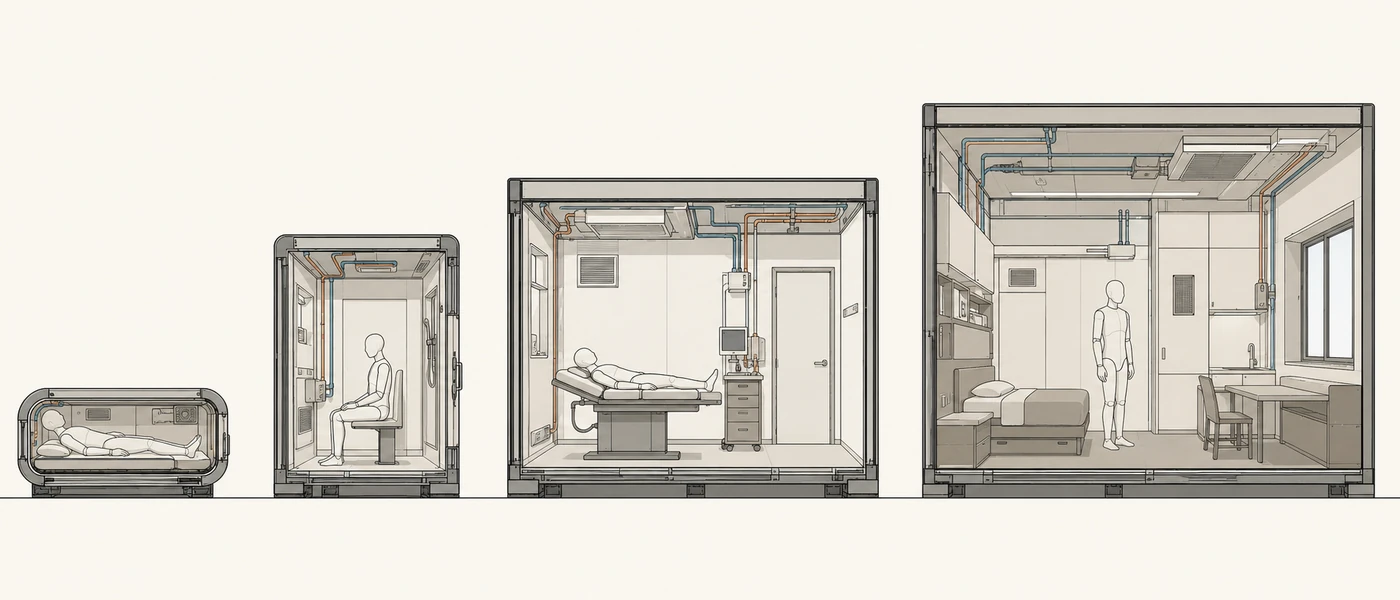
A procedure lasts minutes. Sleep and rest last hours. A course runs days to weeks. Residence is open-ended. A sleep capsule, a regeneration chamber and a longevity apartment draw on a partly shared component base and are otherwise different machines. As occupancy lengthens, the life-support share grows and sensing must become continuous rather than sampled — until, at residence, life support is no longer a supporting system but the substrate the other two functions stand on.
It is also the axis along which the loop actually closes. Over minutes you can only dose. Over a night you can measure and adjust. Over weeks you can learn the individual rather than the population — which is the only version of this that was ever worth building.
Where the boundary sits is the second axis, and it is independent of the first. A boundary can be architectural, and then the person comes to it. It can travel — a deployable bay, a transport capsule — and then it goes to the person, which is the case whenever care cannot wait for a building. Or it can be worn, and then it stays with the person continuously, which is the only arrangement that survives a normal life. Architectural boundaries buy the most control: full life support, shielding, an atmosphere held to specification. Worn boundaries buy the most time, and time is what the loop needs to learn anybody. Most of what will actually be built sits between the two, and a system designed at one point on this axis rarely transplants to another.
Where this has already been done
The most developed engineering answers to “build an environment that actively maintains a human being inside it” did not come from medicine as ordinarily practised. Four adjacent fields arrived first, each contributing something the others did not.
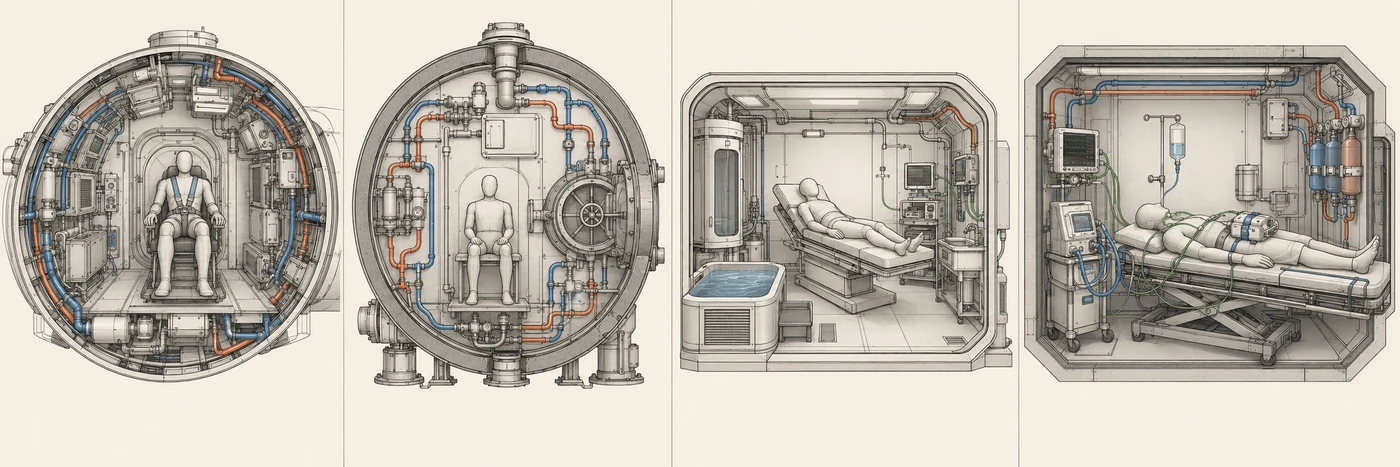
Spaceflight built the closed habitat. Closed-loop environmental control and life support; countermeasures against deconditioning; radiation shielding as a design constraint rather than an afterthought; circadian management where no natural cue exists; autonomous diagnostics and telemedicine at a distance from care. Orbit is the same degradative load with the dial turned up and the timescale compressed, which is why the discipline matured there first.
Diving and hyperbaric medicine turned pressure and gas mixture from ambient givens into controlled design variables — and, in saturation diving, produced the working precedent for residence-mode occupancy: people living for days inside an engineered atmosphere, with the physiological consequences of that atmosphere accounted for by design rather than endured. The treatment chamber is the oldest integrated device in this area, and the oldest one whose dose is written down.
Sports medicine industrialised dose–response for recovery. Load management and periodisation, contrast and cold protocols, altitude and hypoxic conditioning, sleep treated as a managed variable — and, at elite training centres, the first multimodal recovery environments that were actually built, staffed and iterated rather than proposed. It is also the field with the most direct experience of what happens when recovery modalities are stacked faster than they are evidenced, which makes it a cautionary inheritance as much as a technical one.
Emergency and military medicine is where the loop is being closed right now, because that is the setting that cannot wait for a clinician. Prolonged casualty care assumes the helicopter is not coming: a wounded person held for hours or days, far from a surgeon, with sparse data and degraded communications. What that demands is exactly a closed loop — sensors on the body, a model that forecasts the physiological trajectory rather than reporting the current state, and delivery that acts on the forecast. Defence research agencies are now openly soliciting the missing piece, the multiscale reasoning that connects a molecular event to an organ failure to a clinical outcome, explicitly for use where data is sparse and infrastructure is gone. The resuscitation capsule and the forward casualty bay are the purest examples of the object this page describes: enclosures where all three functions are mandatory and none can be called supporting.
The other three fields contribute components and precedent. This one contributes the control problem in its hardest form, and it contributes urgency — because a loop that has to work with no operator, no evacuation and no second chance is a loop with nothing decorative left in it.
The inventory is not closed, and the direction of travel is clear
A field defined by what can be integrated does not get to declare its component list finished.
Candidates arrive from several directions at once and with wildly unequal pedigrees. Some come from traditional practice iterated for centuries and never written up — bath houses, contrast rituals, seasonal regimes. Some come from industrial and environmental engineering, which has been controlling atmospheres, filtering air, attenuating fields and designing transition spaces for reasons that had nothing to do with longevity. Some come from the adjacent fields above. And some come from consumer wellness, which is where the loudest claims and the thinnest support tend to arrive together.
Salt aerosol rooms; air treatment, ionisation and humidity regimes; contrast and cold protocols; conductive and shielding surfaces; materials chosen for their electromagnetic properties; buffer and transition architecture borrowed from cleanroom and airlock practice — these are examples of what is currently in view, not a settled list, and several have not been examined here yet at all.
The palette is also widening in a second direction, and this one has a clear vector. Much of what medicine delivers is still delivered by hand: an injection, a manipulation, a procedure, a session with a practitioner. Each of those is a candidate for delivery inside an instrumented enclosure — an infusion driven by a pump under a controller rather than a clinician's judgement of the hour, mechanical work applied by an actuator that logs what it applied, a procedure performed in a room that recorded the conditions it was performed in. The qualifying question is not which department a modality historically belongs to. It is whether it can be delivered inside the enclosure, dosed, and measured. That question admits far more than the equipment catalogue this atlas started from, and it excludes far more than a wellness brochure would.
Being a candidate is not an endorsement, and being examined is not the same as being recommended. The grading is where judgement happens, one claim at a time, and the middle tier is a frontier rather than a waiting room for approval. What this field cannot afford is the opposite error: filtering candidates by whether they resemble the right kind of technology before anyone has looked. Selection belongs at the design stage, where a specific enclosure is specified for a specific person and purpose. It does not belong at the point of collection.
Four things this is not
Not regenerative medicine. That field acts inside the body — cells, tissue, organ. This one acts on the conditions the body is in. The two are complementary and routinely confused, and the confusion mostly runs one direction: environmental claims borrowing the credibility of cellular ones.
Not a proven result. “Regenerative” here names a direction of engineering. It describes what the environment is built to oppose. Whether any specific component achieves anything is a separate question, answered separately, one claim at a time, by evidence.
Not a category that escapes ordinary evidence standards. Integration does not confer efficacy. A room containing eleven modalities is not thereby better than a room containing two; it is a room with eleven claims to substantiate instead of two. Combination is where evidence is thinnest across this entire area, and saying so is part of taking the field seriously.
Not a market claim. This atlas is a map, not a marketplace. Regulatory registration or clearance is a market-access fact and never proof of effect.
An umbrella term has lately attached itself to this area: quantum medicine. It is used loosely and carries in a good deal that does not survive contact with evidence. It is not adopted as a name here, and not treated as disqualifying either, since the work being pointed at is real engineering whatever the label around it. Readers arriving by that term will find the same content, graded the same way, under a description of what is actually happening.
How this connects to the rest of the atlas
The atlas grades components: what each modality is, what mechanism family it belongs to, what the evidence record shows, and where a claimed mechanism contradicts established physics. This page states what the components get assembled into, and to what end.
The grading discipline carries over without exception. Nothing in the integration framing softens a verdict. A modality that is untested remains untested when it is installed in a capsule; a modality tested and not confirmed does not recover by being combined with one that works. The value of building this way is that it makes the assembly explicit — and an explicit assembly can be evaluated, which a wellness suite of unstated parts cannot.
Illustrations on this page are AI-generated.